
What Is Customer Experience in Insurance? #
Customer experience (CX) refers to the full journey a customer has with an insurance company—from initial awareness and onboarding to policy servicing and claims. In the life and health insurance sectors, delivering superior CX means providing consistent, personalized, and frictionless interactions across all digital and human touchpoints.
The Importance of Customer Experience in Insurance #
Customer experience (CX) has become a defining factor for success in the insurance industry. As policyholders increasingly expect personalized, digital-first interactions, insurers must reimagine the way they engage with their customers throughout the entire policy lifecycle. Here’s why CX is more critical than ever:
- Customer Experience: Delivering a seamless and intuitive customer journey is no longer optional—it's expected. From quoting and onboarding to claims and renewals, every interaction contributes to the overall perception of your brand. A well-orchestrated CX builds trust and boosts long-term engagement, ultimately leading to higher retention and stronger relationships.
- Customer Satisfaction: Satisfied customers are more likely to renew their policies, refer others, and leave positive reviews. By proactively addressing pain points and providing timely, relevant service, insurers can increase Net Promoter Scores (NPS), reduce churn, and turn policyholders into loyal advocates.
- Operational Efficiency: Improving CX often goes hand-in-hand with optimizing back-office operations. Automated workflows, streamlined data management, and integrated systems reduce errors and manual effort—accelerating response times and freeing up resources to focus on higher-value activities.
- Brand Awareness: A superior customer experience naturally contributes to a stronger brand. Happy customers amplify your reputation through word-of-mouth and digital channels. In a market where trust is vital, a reputation for excellent CX can be a powerful differentiator that drives visibility and credibility.
- Competition: With insurtech disruptors and customer-centric models reshaping the landscape, traditional insurers must elevate their CX to stay competitive. Organizations that prioritize experience design and digital transformation are better positioned to adapt, innovate, and capture market share.
—Dan McCoach, Head of North America Insurance, Life & Health, Celent
How do insurers provide superior customer engagement? How do they provide the kind of service consumers have come to expect because of their everyday interactions with businesses ranging from online retail to streaming services to food delivery?
The solution requires more than just creating a singular awesome client experience. Rather, a real competitive edge is built when a insurer is able to create customer journeys in which every interaction with the organization, whether online or offline, builds confidence and trust.
What is Customer Engagement? #
Customer engagement refers to the ongoing interactions between an insurance company and its customers—across channels, touchpoints, and stages of the policy lifecycle—that foster deeper relationships and encourage active participation.
What are the Top CX Challenges for Insurers? #
As insurers strive to modernize and personalize the customer journey, they face a new wave of complex CX challenges driven by emerging technologies and shifting expectations. From implementing AI and machine learning for predictive insights, to capturing and acting on real-time customer feedback, the pressure to innovate is constant. Explore these CX challenges in more detail. Read the best practices so that you learn how to counter the challenges below.
Customer experience in the insurance industry across the customer value chain #
Going forward, insurers need to consider engagement as part of every process, product and policy event. It’s important to be continually improving customer experience in the insurance industry. Having a great UI/UX has become table stakes. Many insurers have developed simplified products. Most have some form of self-service portal. But real advances in customer engagement come from taking a holistic approach and cutting horizontally across the entirety of the customer value chain.
Rather than implementing a series of un-related solutions, insurers need to rethink and reimagine how they are connecting with clients across the entire insurance landscape. What is the overall story that is being written by insurers and customers together? How does each element of each interaction contribute to the overall quality of the journey?
A critical generational shift drives the need for new engagement approaches #
Superior client engagement requires a deep understanding of your different audiences and how their needs are evolving. Almost all customers, and especially the younger generations, have different expectations around technology, relationship and speed of satisfaction. Consider how those heightened needs for greater personalization, real-time decision making, and multi-channel access affect each step in the customer journey. Question every activity along the workflow and look for improvements.
Start by examining how you engage with potential clients before a sale is even made. How are your products marketed? How do you communicate the essentials about your services in a digestible way that people can act on?
—Kartik Sakthivel, Vice President & Chief Information Officer, LIMRA/LOMA
How can insurers make it easy for clients to get quotes, understand the details of what they’re looking to purchase and then easily apply?
And, how can insurers streamline critical processes like approvals and claims? It can’t take weeks for an approval decision to be made. insurers need to develop ways to issue policies faster through automated, accelerated underwriting programs.
And how do we continue to engage with clients over the lifespan of a policy? How do their expectations affect everything from billing to service to claims?
—Kartik Sakthivel, Vice President & Chief Information Officer, LIMRA/LOMA
Each of those steps in the client journey is an opportunity to increase overall engagement and continue to build satisfaction, trust and relationship over time.
What are the client engagement challenges insurers face? #
— Ray Adamson, Vice President, Insurance Solutions, Equisoft
Data challenges #
One of the biggest hurdles insurers face is leveraging their data to enhance customer engagement. Our industry is built on a foundation of a tremendous amount of data. But it’s not always easy to access or leverage. In many cases, the data isn't as clean or as accurate as it could be. All of those data concerns make it hard to gain deep understanding of an individual customer’s needs. And, that makes delivering hyper-personalized service very difficult.
Legacy core systems challenges #
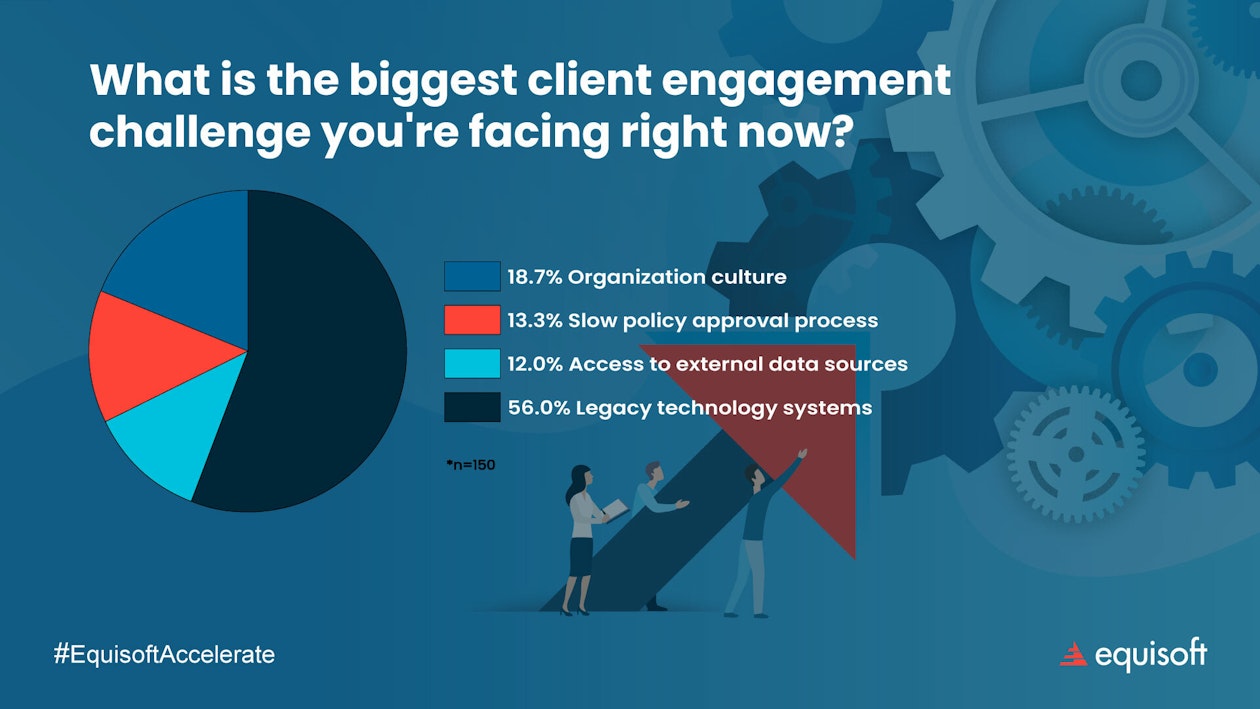
During Equisoft’s recent Driving Digital Client Engagement Through The Entire Insurance Value Chain webinar, we asked attendees: What is the biggest client engagement challenge you’re facing right now?
Best Practices for Customer Engagement in Insurance #
To succeed in today’s competitive insurance landscape, insurers must go beyond traditional service models and adopt forward-thinking strategies that foster deeper connections with customers. Here are the best practices for driving meaningful engagement:
- Customized Personal Experience: Tailor every touchpoint to the individual policyholder. Use data and insights to personalize communications, product recommendations, and support—making customers feel seen, understood, and valued. Understand customers and their unique journey to the degree that you can offer them cross-sell/up-sell services when they are interested. i.e. when they have just had a child.
- Employee Training: Equip frontline staff with the tools and training they need to deliver empathetic, knowledgeable, and efficient service. A well-trained team is essential to creating positive, high-impact customer interactions.
- Omni Channel Strategy: Meet customers where they are—whether on mobile apps, websites, email, or in-person. An integrated omnichannel approach ensures a seamless and cohesive experience across platforms.
- Product Simplification: Simplify policy language, onboarding steps, and claims processes. Clarity and ease reduce friction, boost confidence, and encourage customers to take action.
- Customer Feedback: Regularly collect and analyze customer feedback through surveys, reviews, and NPS tools. This provides insight into pain points and opportunities for continuous improvement.
- Mobile Friendly Documentation: Optimize forms, policy documents, and account access for mobile devices. Today’s customers expect fast, easy, on-the-go access to information and services.
- Consistency: Deliver consistent experiences across all departments and channels. A uniform brand voice, process, and standard of service builds trust and reliability.
- Integrations: Integrate CRM, policy admin, and customer service platforms to provide a 360-degree view of the customer. This enables faster, more informed responses and proactive service.
- Communication and Support: Maintain clear, timely, and proactive communication throughout the customer journey. Transparency—especially during claims and renewals—reduces uncertainty and enhances satisfaction.
- Notifications: Keep customers informed with real-time notifications for payments, policy changes, renewal dates, and claims updates. These timely alerts improve transparency and engagement.
- Support Service: Provide responsive, multi-tiered customer support—including live agents, knowledge bases, and self-service tools—to meet diverse customer needs efficiently.
- Leverage AI and Chatbots: Use AI and chatbots to offer instant responses, 24/7 assistance, and predictive insights. These tools enhance service speed and help scale support while maintaining a personalized touch.
- Data Security: Demonstrate strong data protection practices and compliance with privacy regulations. Building trust through secure, ethical data use is fundamental in maintaining customer relationships.
How to Engage Customers in Insurance #
Building lasting relationships in the insurance industry requires more than just reliable coverage—it demands proactive, value-driven engagement. Here are proven ways insurers can enhance customer engagement:
- Rewards: Offer loyalty programs, discounts, or wellness incentives to reward customer behaviors such as safe driving, healthy lifestyles, or timely payments. These perks build goodwill and encourage ongoing interaction.
- Customer Service: Deliver fast, empathetic, and knowledgeable support at every touchpoint. A positive customer service experience reinforces trust and keeps policyholders engaged.
- Access: Make it easy for customers to access their policies, documents, and support tools—anytime, anywhere. Self-service portals, mobile apps, and 24/7 availability are essential.
- Gamification: Incorporate game-like elements such as progress tracking, milestone rewards, or interactive tools to make engagement more enjoyable and motivating for users.
- Communication: Use proactive, personalized communication across preferred channels—email, SMS, or in-app messaging—to keep customers informed and involved in their insurance journey.
- Claims Processing: Streamline the claims experience with digital tools, clear instructions, and real-time updates. A fast, hassle-free process greatly improves customer satisfaction and engagement.
- Educational Content: Share relevant, easy-to-understand resources that help customers make informed decisions. Topics like risk prevention, coverage options, and financial planning empower and engage.
- Community Support: Create opportunities for customers to connect through forums, webinars, or social media. Community-building fosters a sense of belonging and trust in your brand.
The Role of Customer Retention in Insurance Growth #
Customer retention is key to sustainable growth in the insurance industry. It’s more cost-effective to keep existing policyholders than acquire new ones—and loyal customers are more likely to renew, expand coverage, and refer others. Both customer experience and engagement play vital roles in retention. A smooth, consistent CX builds trust, while ongoing engagement keeps customers connected and invested in their relationship with the insurer. Together, they reduce churn and create long-term value, fueling overall business growth.
Choose the right modernization strategy #
Insurers are challenged to look ahead three to five years and decide what technologies the organization will need in order to fully engage with customers going forward. And they’ll also have to look back, because that strategy will need to consider how the insurer can overcome their accumulated technical debt and the drawbacks of their legacy systems.
Adapting or building on top of existing legacy technology improves an organization’s connection with existing policy holders. But it’s cumbersome when you have multiple core systems and at some point, insurers will hit the limits of what their old systems can provide in terms of future capabilities and value.
On the other hand, taking a greenfield approach can enable a insurer to really build out the best, most fully realized engagement model.
— Sanjay Kaniyar, Partner, McKinsey & Company
Integrating with older systems or replacing them with modern platforms may take a lot of effort and investment. But if we have defined our vision for customer engagement and the technologies that will be required to achieve it, then insurers may find that investments made today will set the stage for customer success for years to come.
To learn more about how to improve customer experience and engagement in the insurance industry, watch the Equisoft Accelerate Series webcast: Driving Digital Client Engagement Through The Entire Insurance Value Chain.


