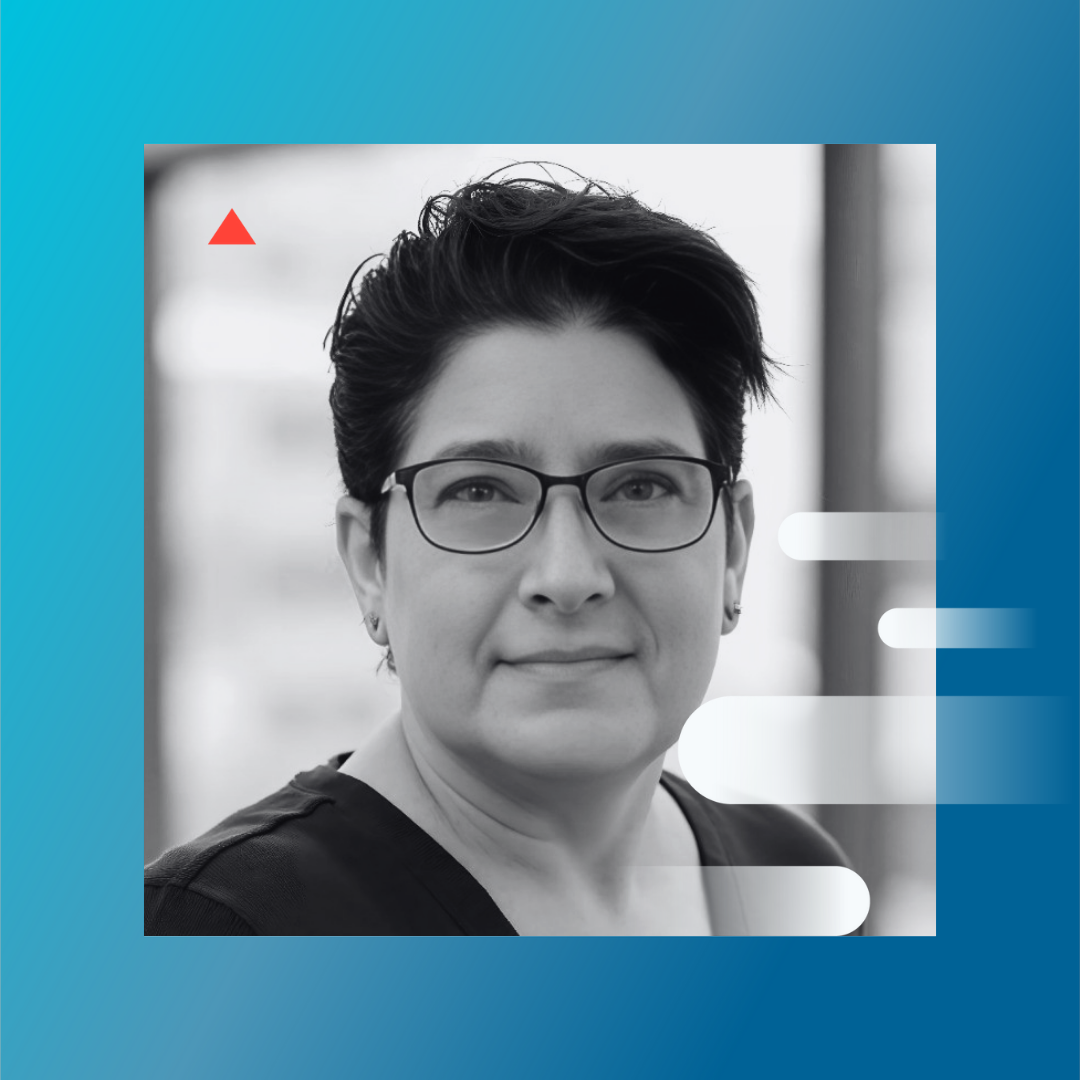
Ann Mengelson-Clark:
The responsibility and the discussions around AI business cases is more distributed now. I would say it's not formalized with it being the full-time job of any one person. I can say that's a really good pattern, that it's not just formalized in technology. So that's not all bad. We have not had a shortage of usage cases come up because as we onboard new vendors and look for new capabilities, nearly every, well, every current technology and every new technology is starting to have AI baked into components of it.
Olivier Lafontaine:
Hi Ann. Without going into much introduction, maybe we can start on a couple of questions. First, can you tell us a little bit about yourself? I like to do this in this podcast as we talk a little bit of what people do in their spare time and personal things that they care about. So you told me in the preparation you do a little bit of cooking and hosting in your family time. So why don't you tell us about that a little bit?
Ann Mengelson-Clark:
Sure. Glad to tell you about that. What's interesting is as I've gotten to know myself a little bit better, I used to think that I like to cook. What I found out is really, I like to feed people. I like to host people. I like to get a group together and enjoy the camaraderie there. So what I really like to do is host gatherings, including planning the menu and things like that. So that's what I like to do when I'm home.
Olivier Lafontaine:
That's amazing. Good stuff. And if you tell us a little bit about your company, where the history lines of business
Ann Mengelson-Clark:
Could also share a little bit about what I like to do when I'm not home.
Olivier Lafontaine:
Oh yeah, absolutely. Go ahead.
Ann Mengelson-Clark:
Well, one of the things I really like to do on vacation is my work life is fairly hectic, so one of the focus points we have on vacation is to relax a little bit, and scuba diving is one of the ways that I really enjoy doing that. It's really nice to be underwater. It's silent except for bubbles that is rare above the waterline, and so it's something I really enjoy. My team finds that I'm a little less reachable during those trips, which they probably consider a feature, not a bug, if I'm honest with you. So that's what I like to do on vacation.
Olivier Lafontaine:
Good stuff. Recently I went to Mexico and they have, I think they called them cenotes, which are underwater caves. So that sounded very intriguing. Have you ever done something like that?
Ann Mengelson-Clark:
I have not yet explored the underwater caves, but I'll have to put that on my to-do list.
Olivier Lafontaine:
Yeah, I don't do much scuba diving myself, but that is one thing. I have to at some point get over the fear because the cave in itself is a thing and then there's the underwater to chat about.
Ann Mengelson-Clark:
I've explored small caves but nothing extensive. So looking forward to that. Thanks for the idea.
Olivier Lafontaine:
Good stuff. Alright, so onto more serious things I suppose so and is that how you pronounce the name of the company, Kuvare?
Ann Mengelson-Clark:
That is Kuvare,
Olivier Lafontaine:
Yeah.
Ann Mengelson-Clark:
We'll show up regardless of how you pronounce our name, but we say ver.
Olivier Lafontaine:
Okay. Can you talk a little bit about the history lines of business and how distribution works for the company?
Ann Mengelson-Clark:
Yes. So Kuvare was formed in 2015. I met them around that time approaching 2016. It was just one person. When I met Kuvare, it was our current founder and folks looking to make an acquisition of a company that had good bones. They found that in Guaranty Income Life, which is where I was working, Kuvare acquired Guaranty Income Life, a small company in Baton Rouge, Louisiana in 2016 and then proceeded to inject levers of growth. So we grew by leaps and bounds. Fast forward a bit after much company growth, we acquired another company in Cedar Rapids, Iowa, and that's when they tapped me to lead IT operations for the company. We focus on the middle market fixed annuities, fixed index, annuities, index. Universal Life is a part of our portfolio. Single premium annuities. We have multi-channel distribution. One of the simple things I tell new employees is the agents, the advisors, they don't work for us. They can sell for anyone and we hope they sell for us. We deal with independent marketing organization, banks, credit unions, broker dealers and independents. So we have a lot of financial professionals as our customers to please.
Olivier Lafontaine:
Well said. So having gone through these acquisitions, how do you feel about them? There must have been a little bit of a chaotic times and interesting personal challenges.
Ann Mengelson-Clark:
It has definitely been interesting. After those two companies, a couple of years later, we acquired yet another company that had a very large closed book of business. So those three acquisitions provided us with the capabilities that we needed. But everything after that and during that was organic growth. So constant change since 2016, my team's grown from two or three people to about a hundred people. The company itself has grown dramatically. We have had to adjust the way we do business every year or two. There are some days we bring in more premium in a day than we used to bring in a year. So that change has been very, very exciting for me and for my team. Generally technologists appreciate a problem to solve, a puzzle to work with and a challenge and certainly has been exciting to see our growth, our acquisitions are very strategic and each one gave us more to work with. The companies and the people at them were terrific additions to the team. If you remember I said we started as one person. We did not start as a giant company acquiring smaller companies and folding them in. Instead, we put together the structure with the companies we acquired and we kept a lot of their capabilities and culture to make us all better.
Olivier Lafontaine:
Yeah, it's a good occasion for learning. I've been through that myself to be honest, in the acquisitions that we've done in equisoft and you try to get same thing for us. We are not a gigantic software company, so we've had the occasion to learn from the companies that we acquired. So that was really good for the team. So switching gears, tell us a bit more about your role and so your chief technology officer, which I think we've talked about this before, it's a little different. We usually we hear chief information officer at most insurance companies and annuity companies. So why don't you go through your background a little bit and the different roles you've had and maybe what your role is today and how this came about.
Ann Mengelson-Clark:
Absolutely. So I can tell you how I got started and then where we are today. I've frequently said that my first role in insurance was as a business analyst, but looking back a little further, my first role in insurance was actually as a human resources receptionist as a college student. So I did that for a summer gig and I really didn't know what I was seeing in the world of insurance, but I certainly knew that it was very interesting to see where people ended up in their careers and I had a very good window into that as someone in hr. It was also one of my first forays into technology because as a receptionist there were some down periods where instead of answering the phone and doing job verification checks, I started working with the team to automate some of the things that they were doing.
Fast forward a bit, my educational career was in the life sciences, biology zoology, and as I moved into a graduate program that would have me on track to be in science and research and do a lot of laboratory work, I decided that is not where I wanted to spend my time. That is not the way I wanted to spend my day. I wanted to focus more on macro problems instead of micro problems. So I finished my studies and I set out to find a job in an IT department having spent zero time in my academic life or in my work experience in that field. So I was looking for someone that would hire an individual that could problem solve and learn from a book. Luckily I found a good fit as a business analyst at a life and annuity company and that turned out to be a very good opportunity for me and it launched my career.
So the way it worked is I was in a department that was called model Office at the time, SAT in between customer service and development, did that for a year. Then the company got acquired, my boss went somewhere else, I did a little bit of light software development and then I got a call. She said, so Ann, I'm now the head of an IT department. It's very small, our systems are crashing nearly every day. Can you come help us out? Don't you want to be a systems administrator? I said, I do. I do want to be a systems administrator, but I haven't done that yet. She said, don't worry, I'll hire consultants until you figure it out. I just need someone who can problem solve and manage to get us on the right track. So that was my first
Olivier Lafontaine:
into IT.
Ann Mengelson-Clark:
Yeah, that's right. But it wasn't because it was business analyst. That's what I was going to say.
So that was my first introduction to management in the insurance world and it started as a systems administrator, which is a very generalist sort of role. It let me wear many, many hats all the way from contract management to supervising developers in some cases, which was a great way to get further along in my IT career. Our parent company also owned radio stations, so shortly after I was hired by the insurance company, I became the head of technology for our five radio stations as well. That also made for an interesting challenge. That was back in the days when streaming was new, when HD radio was new, it was a very good way to build a smart team that was very capable of getting things done.
Olivier Lafontaine:
And then fast forward to, I think you said 2018 you became head of Kuvare it.
Ann Mengelson-Clark:
Yeah, fast forward to 2016 when Kuvare acquired us and then in 2018 when I became head of technology, so my title's a little confusing sometimes. Chief technology officer, I'm the chief technology officer for our three insurance carriers Guaranty Income Life, United Life and Lincoln Benefit Life. I'm the vice president of technology for couver. Overall, I'm the head of technology for guts, the way to think about it most easily.
Olivier Lafontaine:
Good stuff. So if we were to talk, the podcast is about digital transformation, so that can mean lots of things. So for you and I suppose for your company, how do you think about that? I mean you've talked about the growth, the acquisitions, I'm assuming transformation. I don't know if you used that vocabulary, but some form of digital transformation must have been required at some point either to amalgamate the different companies or transform certain processes that were outdated and stuff like that. How do you think about it internally?
Ann Mengelson-Clark:
Absolutely. Digital transformation has been on our minds since the very beginning. As simple as we still had a lot of paper processes that needed to be made, digital and digitalization was key to us overall in our digital transformation. If you think about people, process and technology on the people side, we've restructured our teams with every step of growth and we've formed teams so that the people who make decisions about the customer experience sit for instance, in the same meetings as the folks who build the technology around that, that means we can make a decision in a day instead of weeks. So the people side has changed a lot that way. On the process side, our transformation has involved changing the way our projects run a bit moving towards a more product mentality. So tech operations, distributions solve problems together from day one, makes things a lot more efficient.
As I mentioned, our technology originally even had some focus on getting paper to platform, modernizing some systems. We have some legacy systems in the mix integrating our data and as we acquired companies that became more and more important so we could get a single view of things in order to get the right insights. And most recently our transformation has focused on the digital experience, a platform to unify our financial professional and policy holder experience. Overall, our focus is not just on new technology, it's mostly about making ourselves easier to do business with internally and externally.
Olivier Lafontaine
So you've prioritized, I suppose, the digital aspect or the interface perhaps with the market or the advisors who are in a certain way, your customers, I guess if they're obviously not your employees, over perhaps the foundation transformation. Is that a fair statement? Have you done any policy admin replacements? So you're more started with the digital aspect of it or the front end aspect of it?
Ann Mengelson-Clark
We started with the backend in fact. So one of the ways that we needed to grow was to build new capabilities on the core systems side. So the first thing we did was change our main platform and operations model for annuities so that we could get into a new product line. Our annuity technology and operation system is now the same for all three companies, so it makes it a lot simpler strategically. So that was the way we started and it involves slightly different initiatives for the first two companies, the third company was actually already using the same platform, so it made things much simpler. So we've done it a little bit at a time. Our transformation paper to platform for annuities was the first thing to do. Core systems, policy, admin systems, all of that. And then most recently our transformation has involved what you actually see as a customer or a financial professional or policy holder, the digital experience, our portals.
Olivier Lafontaine
Okay, good. And when you said something around, so the teams getting together, the people that make the decisions about the customer experience, and I think you said the people that execute on the solution perhaps maybe I'm not quoting that properly, but tell me more about that. I think that's interesting, but what do you mean by that? Who are the people that make decisions about the customer experience and the IT people? What does that mean in concrete terms?
Ann Mengelson-Clark
Let me explain how we started our portal transformation and it will make a lot more sense. When we first decided to unify the Asian experience and the policy holder experience, we had multiple portals for public, for financial professionals, for two different companies. Our life portals were different from our annuity portals and we set out to unify those things. What it meant is for our first kickoff meeting, we had to have 30 people in a room.
Ann Mengelson-Clark:
So it was difficult to find a unified business owner as we've moved through and unified things and fast forward as we move through two or three years of that journey, it has been much more possible to find key business owners that can help us make decisions. And it used to be that we would have to get 30 people in a room to have the business side and the technology side together. Now we can have a much more manageable group. So that's what I mean. There's not a throw something over the wall approach. We all gather together. We amplify good ideas that might be quiet. We make sure that we are adapting to the good ideas in the room and then we move forward. But I guess my main point is that we don't do that in isolation. Our teams are very integrated with the business side, especially on the digital side of things.
Olivier Lafontaine:
Was this made through organizational change or as just by sort of getting to teams to work together more? Was there changes in who reports to who and things of that nature or more communication to say, Hey, you guys must sit together or make certain people responsible? From the business perspective,
Ann Mengelson-Clark:
It was a combination. We worked with the business to identify key roles that they could put in place to help lead initiatives across their different lines of business and we also restructured technology teams. We restructured into multidisciplinary pods on the IT side of things to align with the business value streams.
Olivier Lafontaine:
That's good. A lot of insurance companies and annuity companies are doing that as well, and I think that has been a successful model as opposed to a IT functional aspect, right, where you have all your bas together, all your programmers together, which then becomes less focus on the business problems that you're trying to solve. Would you agree?
Ann Mengelson-Clark:
I agree completely. That model worked for us when we were smaller as we grew and needed to move more quickly and as technology changes exponentially faster and needs to keep pace and be in the loop and at the table with business decisions, that model was just too complex and it was just too complex to move quickly enough and it's much clearer to our technologists what business problems they need to solve when they have a clear business focus and it's much clearer to the business what they need to do to help us move forward with technology when we're all part of the same team. Now we are not in a fully agile model where business and IT are happily integrated fully. That doesn't happen all that often, especially in the areas of insurance. We're not exactly usually on the bleeding edge of technology and transformation, though we are getting faster and faster, I would say.
So there were definitely some roles that needed to be filled out a little bit on the business side, but most of our transformation was in the alignment and the realignment of the teams. On the IT side, I'm probably alike a lot of my colleagues, which is I'm only in charge of the technology teams. I can't exactly dictate to the overall company how it is that we're going to change, which is fine because we are all leaders in this together. Our strategy was to learn and lead by example and in many cases what that turns into in reality might be a business person meeting with one of our IT pod teams as if they reported to it when in fact they don't. But we don't worry too much about the hierarchy. We worry much more about solving problems than who reports to who and who just get credit for what.
Olivier Lafontaine:
Great. So if we go back to, and I was going to ask you, I did not ask you about results, but that was going to be my next question. So have you been able to see certain things that came out of the projects you've done in the last couple of years? Have you been able to measure the outcomes? Sometimes that's a little difficult and maybe not measure, but just anecdotally, what are some of the projects that you've gone through and how that's unfolded for the company?
Ann Mengelson-Clark:
Some of our recent projects have been consolidation and modernization of our financial and actuarial platforms, and that was our first use of our transformed IT operating model. And in that we saw immediately better communication among the departments of the organization and a one team mentality that we hadn't seen before. And as a result, those projects stayed in the green a lot more than you'd expect such huge transformative back office projects to go. The portals, the unified portals project was also benefited greatly by our new model and the processes we put in place.
Olivier Lafontaine:
Is that live at the portals project? Is that live that, do the advisors have access and policy holders or is that still in implementation?
Ann Mengelson-Clark:
Yes, our new digital platform, MyKuvare, yes, it's live. It is accessible to financial professionals and policy holders and we have just delivered what we would call phase one, which is mostly a read only experience, but unified and modern and it's very easy to find information there. Transactional capabilities are coming next.
Olivier Lafontaine:
Good. Have you gotten some feedback so far with phase one from the advisor community?
Ann Mengelson-Clark:
We have gotten feedback as you'd expect with financial professionals or any of us in the day-to-day. The feedback is yes, that's good. Now I want more. So we're already working on that.
Olivier Lafontaine:
Yeah, I've been there. We have a portal product ourselves that we implement on top of our policy admin solution and yes, that is oftentimes when you try to do, first of all, you always have to do phase projects, but then there's only so much communication you can do to the field and they always expect more, but that's good. It's in the right direction. So that's what's important.
Ann Mengelson-Clark:
Speaking of being in the right direction, I've talked about our initiative of the digital platform being mostly about portals and that's not exactly a balanced representation of what we achieved because what we achieved in addition to just working together differently internally, a back office system that will support the exchange of information in other ways. As you may know, independent financial professionals might want to go to a portal a little bit more than someone say in an independent marketing organization that might expect data feeds or APIs. So the data standardization and the service model that we have built to support the portals is also going to support better interfaces for our distribution moving forward. We're moving beyond batch file exchanges towards more immediate connected data sharing, for instance, and that will offer more functionality than just portals to our distribution
Olivier Lafontaine:
In the prep. You also had, I had in my notes modernizing data file and extending the usability of the data for creating reports and things like that. Do you want to talk about that a little bit?
Ann Mengelson-Clark:
Yes. Data is everywhere. Data is king. With the advent of ai, which I'm sure we're never going to talk about because no one ever talks about that anymore. Data is very important and we've got a lot of it. We have migrated the data from our older systems to improve reporting. Our main goal was for leaders to get what they need in minutes instead of waiting for a custom request. So we have implemented numerous dashboards and it's made our decision makers very happy.
Olivier Lafontaine:
So what does that mean though? It's moving, when you say migration, it's moving data out of the policy admin systems into a centralized system or is it you already had reporting systems and then you consolidated that in one view? Help me understand.
Ann Mengelson-Clark:
We implemented new data systems and we didn't eliminate any of our older core systems, but we utilize a lakehouse for serving up analytics
Olivier Lafontaine:
And create a dashboard of that. So now
Ann Mengelson-Clark:
Creating dashboards from the source systems of our data warehousing that consolidate the information from our core systems including policy admin, commission accounting systems and others so that information is all in the same place and leaders can get access to that where and when they need it.
Olivier Lafontaine:
Amazing. Was that a lot? That must've been a big project. Oh, it must've taken a little bit of time and effort. I would have to assume. And archeology perhaps in passing.
Ann Mengelson-Clark:
Yes, and it continues. The work continues that will never stop. We have a set of data warehousing systems that we continue to modernize and our strategy for that is not necessarily a build it and they will come data strategy that doesn't work so well. It's much more focused than that in that we have a business led strategy. We know in general what we need to provide and we hone in on what we need to provide next very clearly so that when we deliver it, we get it. Right.
Olivier Lafontaine:
Good stuff. And since you mentioned it and we have to have the clicks about AI then let's talk about that for a minute. So have you been, I mean I'm assuming your company does certain things with ai. Where's your journey at? How do you guys see this at the moment and what are some of the initiatives that you're doing?
Ann Mengelson-Clark:
We're mostly using employee tools, AI assistance like copilot chat, GPT. We use those for summarizing long documents. For instance, drafting, communications, researching so that things take seconds or minutes instead of hours or days. We do have a few small pilot programs, mostly around back office efficiency. For instance, we're working with an AI tool to turn complex project plans and into simple visual dashboards so that we can see status priorities at a glance without a lot of manual effort. We're also working with some tools, flag unusual patterns in administrative or security data so that we can find things more quickly. Like a sudden spike of a certain type might be more visible if we can get an AI agent on the case. We are also working on removing extra steps from everyday workflows and such and just kind of starting to get into that area. The largest business facing AI initiative we've had so far other than just making us all more efficient is in the customer service area where AI captures more complete call notes and puts that in front of the call center folks so that the calls have more detail and summarization, including the sentiment of the caller, which might give you a heads up the next time they call.
Olivier Lafontaine:
Yeah, we hear that more and more. That's a really interesting technology and is turning into a real big use case for AI in a lot of industries I guess. But in life insurance in particular, I guess you could know obviously if they're in distress or things like that, so that's interesting. Have you found any compliance challenges or pushback from compliance and legal around the use of ai or do the vendors take care of that for the most part because they've obviously gone through that with multiple clients. What's been your experience?
Ann Mengelson-Clark:
My experience is that when compliance decisions need to be made, it's our responsibility to make those and we can't outsource them. So our compliance legal business and IT teams are all together in the AI conversation and we have an AI governance committee that is much more agile than it would sound just because of the word governance. We make pretty quick decisions and very informed decisions and together we track emerging governance since we still in 48 states, there are a lot of regulations to keep track of, so we do that together. I wouldn't say that we've gotten pushback from compliance. Instead we've gotten curiosity even in AI summits and forums and workshops that it joins. We invite our compliance and legal teams to join with us in those conversations. We've been careful but steady adopters of the technology and our compliance team is supportive. We just try to stay aware and on top of it.
Olivier Lafontaine:
That's good and it's all very fuzzy, I'm sure for your joint team as well, trying to understand, okay, what does it mean, what's acceptable? What is going to be, what's acceptable now? What is going to be acceptable next year? Are you facing those kinds of challenges and philosophical questions at the moment?
Ann Mengelson-Clark:
Yes, we certainly are just like everyone else, it's going to be ubiquitous. AI is going to be part of every technology just integrated, so we can't delay on learning and implementing these things. We just have to keep pace with each other and keep making smart decisions.
Olivier Lafontaine:
Makes sense. And I want to double click. You mentioned agents to help with automating workflows. Can you talk a little bit more about that? That's one that is emerging and we hear more and more about agent a KI on all medias and the internet and stuff. So
Ann Mengelson-Clark:
It's more of a hope than a reality for us. We're looking for those opportunities right now, but it's easy to imagine more and more we find ourselves asking the co-pilot AI tools to do things that you can really only do with an agent. We naturally want to use AI in agentic form because it's more effective. It's like having an extra you to go do some research and then come back. I'm hoping we'll get into that pretty soon because it's really where the efficiency starts to pay dividends.
Olivier Lafontaine:
How do you approach, because for having heard about this from a couple of companies, that one of the difficulties to your point is the hope and even formalizing the use cases for where this would be useful and acceptable. Obviously uploading sensitive medical information into chat GPT, that's going to raise a couple flags that you have to think about and we could make experiments in the time being until we figure out how to do this in a way that's going to be acceptable from a privacy perspective. But so how do you approach this? Do you have people coming up with use cases? You have a small team that is exploring those opportunities. Do you guys view this? Is it a bit more informal than that, how these opportunities surface? Or you're very intentional around, some people have this as their tasks on a day-to-day basis.
Ann Mengelson-Clark:
The responsibility and the discussions around AI business cases is more distributed now. I would say it's not formalized with it being the full-time job of any one person. I can say that's a really good pattern, that it's not just formalized in technology. So that's not all bad. We have not had a shortage of usage cases come up because as we onboard new vendors and look for new capabilities, nearly every, well every current technology and every new technology is starting to have AI baked into components of it. So that has lent itself to our business leaders and our technology leaders both thinking of use cases. So we haven't initiated a large AI focused business initiative, but there has not been a shortage of AI use cases. It's just starting to become part of our normal seizing of opportunities.
Olivier Lafontaine:
That's good. Alright, well this was very interesting. I think we have plenty of material for the presentation, but thank you for coming to the podcast and sharing with us what your views are and what's happening at ver. I really appreciate
Ann Mengelson-Clark:
All right. Thank you very much for having me, Olivier. It's been fun.
Olivier Lafontaine:
Thank you, Ann.